Picture someone in your area who needs exactly what you sell. Before they get in touch with anyone, they’ll probably search on their phone, glance at Google Maps, read a few reviews, check a business’s Instagram and look at its website. Some will skip all of that and ask ChatGPT for a recommendation instead.
Each of those steps is a moment where they can find you, or find someone else.
We’ve been able to see how that plays out for real. Since launch, Lens, our free marketing audit tool, has run 1,292 audits across those six places. Lens gives each channel a score out of 100: the higher the score, the easier a business is for customers to find there. Most have a decent website, but more than half score poorly for AI visibility, and one in four don’t appear in a single AI answer we checked.
This guide walks through the six places local customers look, what our audits show for each one, and what to check for your own business.

The big picture from 1,292 audits
Customers move between search, maps, reviews, social media and AI tools, often within a few minutes, and they don’t think of these as separate channels. To them, it’s all just looking you up.
That’s why a business can be strong in one place and almost invisible in another, and our audits show how common that is.
How to read a Lens score
Every business gets a score out of 100 for each of the six channels, plus an overall Lens score. The higher the score, the more visible the business is in that place. As a rough guide, 70 or more is strong, 50 to 69 means there’s room to improve, and under 50 means customers are likely to struggle to find you there.
The score is a starting point, not a verdict. Each Lens report explains in plain English what’s holding the score back and what to fix first, so you know exactly where to focus.
The average Lens score was 49 out of 100. More than half of the businesses we audited (53%) scored under 50, and only one in seven (14%) scored 70 or more.
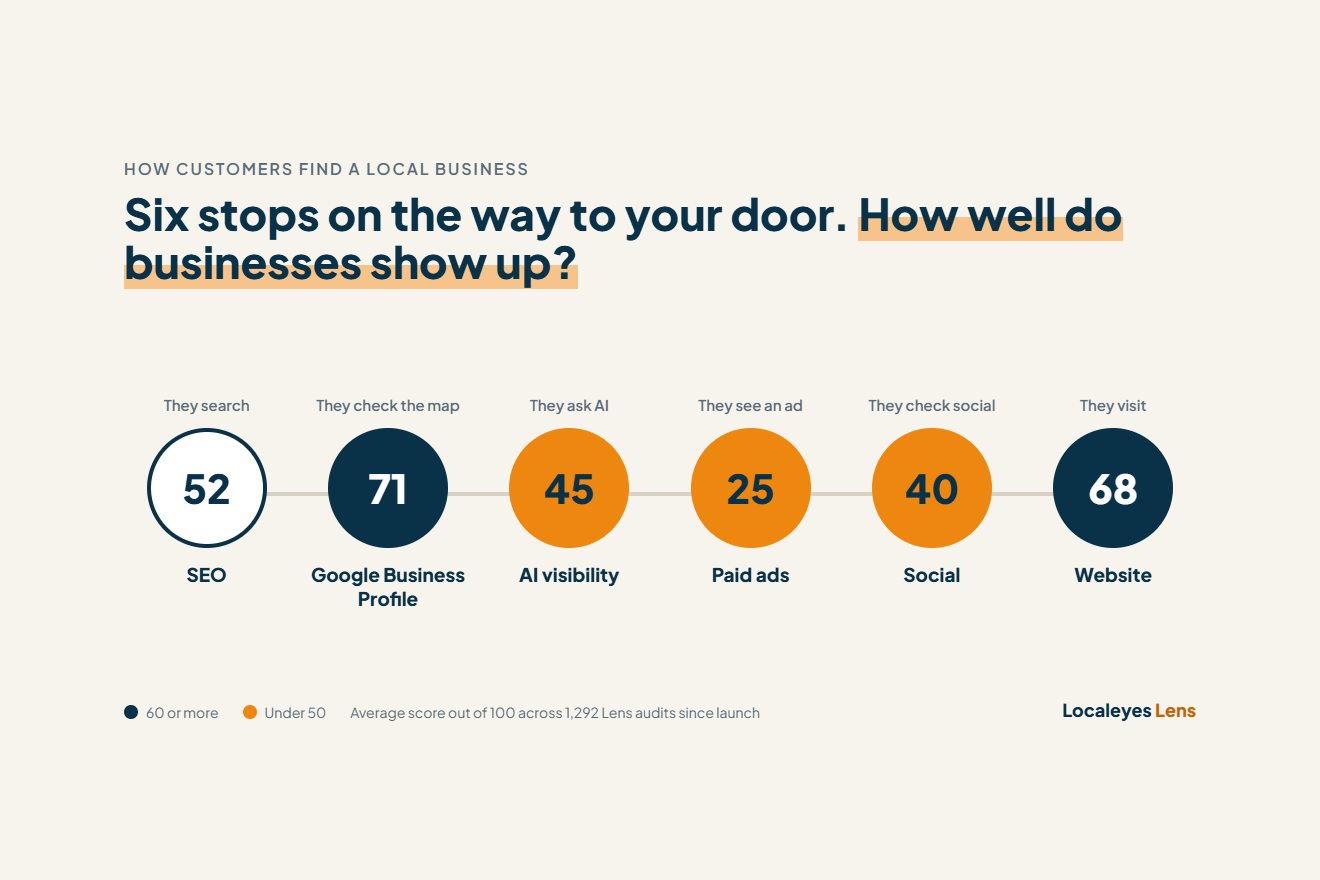
Here’s how the six channels compare, using the average score across all audits so far:
| Channel | Average Lens score (out of 100) |
| Google Business Profile | 71 |
| Website | 68 |
| SEO | 52 |
| AI visibility | 45 |
| Social media | 40 |
| Paid search | 25 |
Paid search scores lowest mainly because most businesses aren’t running any ads. Of the channels almost every business already has, AI visibility and social media are where they fall furthest behind.
About these figures: they come from 1,292 Lens audits run since launch, mostly of local businesses our team were already speaking to, so treat them as an early picture. All scores are out of 100.
1. Google search: half of businesses are only halfway there
Around 46% of all Google searches have local intent. Someone typing “accountant near me” or “emergency electrician” wants a business close by, and usually wants one soon. Organic search also drives roughly 53% of all website traffic, according to research by BrightEdge.
Yet for local businesses, search is close to a coin toss: half of the audits we’ve run scored under 50 for SEO. Showing up comes down to a website that clearly says what you do and where, pages that use the words customers actually search for, and a site Google can read without technical problems getting in the way.
What to check: search for your main service and your town on your phone. Where do you appear, and who appears above you?
2. Google Maps and your Business Profile: the strongest channel
This is the good news. Google Business Profile was the highest-scoring channel in our audits, averaging 71. Motoring businesses such as garages and MOT centres averaged 80, and home and furniture retailers 81.
That matters, because for many local searches the map results appear before any website, and people act quickly. Google’s own research found that 76% of people who search for something local on their phone visit a business within a day. Reviews do much of the work: BrightLocal‘s research shows 98% of people read online reviews for local businesses, and 87% use Google to check one out before visiting.
What to check: open your Business Profile as a customer would. Are your hours, services and photos up to date? When did you last get a review, and did you reply to it?

3. AI assistants: where most businesses fall behind
More people now ask AI tools for recommendations in everyday language, such as “who’s a good wedding photographer near Leeds?” Google has built AI into its own results too: AI Overviews arrived in the UK in August 2024, followed by AI Mode in July 2025, which became broadly available in December 2025. So even customers who never open ChatGPT are now seeing AI-written answers at the top of Google.
This is where our audits found the biggest gap. AI visibility averaged 45, and more than half of businesses (53%) scored under 50. In one in four audits, the business didn’t appear in a single Google AI or ChatGPT answer we checked.
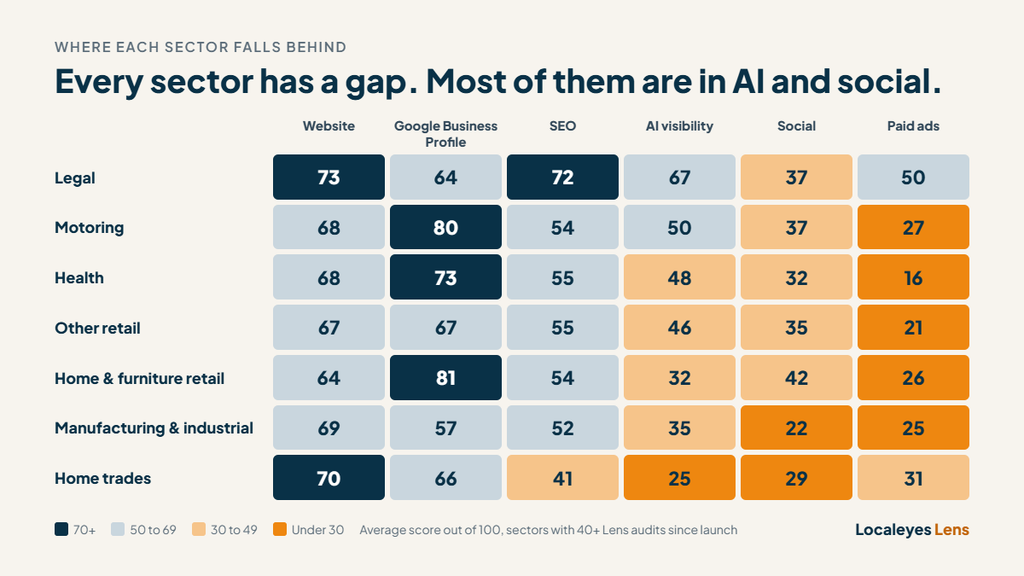
A good website doesn’t fix this on its own. In almost a third of audits (32%), the business had a decent website, scoring 60 or more, but scored under 40 for AI visibility. A strong map listing doesn’t either. Home and furniture retailers scored 81 for their Google Business Profile but just 32 for AI visibility, and half of them didn’t appear in AI answers at all.
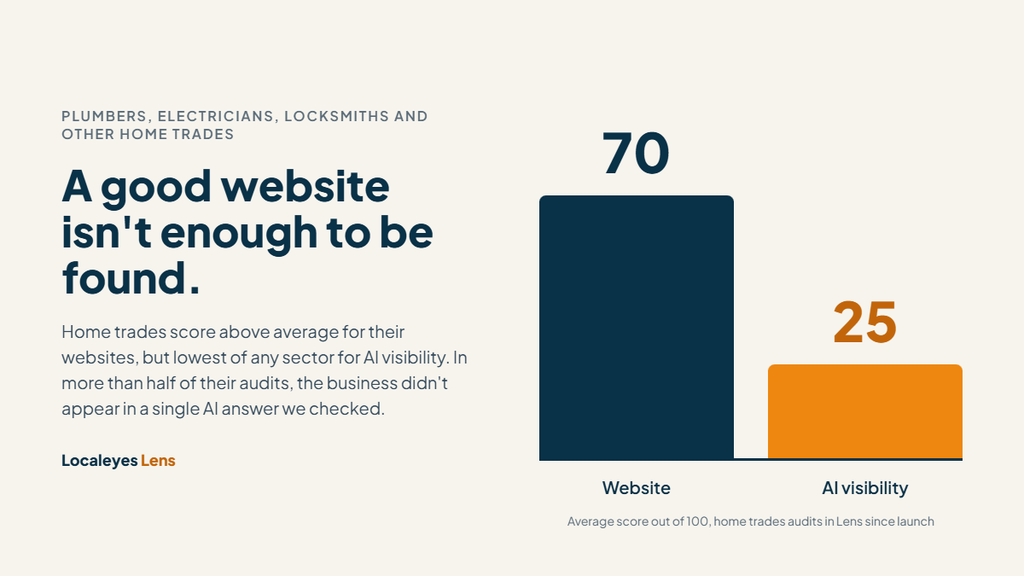
Home trades are the least visible of all. Plumbers, electricians, locksmiths and similar trades averaged just 25 for AI visibility, and in more than half of their audits (54%) they didn’t appear in any AI answer we checked. For businesses whose customers often need someone urgently, that’s a real risk.
AI tools draw on information that already exists about your business: your website, your Business Profile, your reviews and what others say about you online. Accurate, consistent details and genuine reviews make it more likely you’ll be the business they mention.
What to check: ask ChatGPT, and Google, for a recommendation in your sector and area. Are you mentioned? If a competitor is, look at what they have online that you don’t.
4. Paid search: most businesses aren’t there at all
Paid search puts you at the top of the results the moment someone is looking. People who click a Google ad are around 50% more likely to buy than someone arriving through organic search alone, and WordStream’s benchmarks put typical conversion rates for Google Search ads between 4% and 8%.
Even so, almost six in ten audits (58%) found no paid search ads running at all. That leaves the space to competitors, including any bidding on your business name so that people searching for you see them first.
What to check: search for your own business name. Is anyone else’s ad appearing above you?
5. Social media: patchy at best
58% of consumers say they first discover new businesses on social media, and 63% say a positive interaction with a business on social makes them more likely to visit.
Yet social averaged just 40 in our audits, and in one in five (21%) we couldn’t find a Facebook, Instagram, LinkedIn or TikTok profile for the business at all. Manufacturing and industrial firms scored lowest, at 22.
You don’t need to be on every platform. One or two accounts that are active, up to date and linked from your website will do more for you than five that went quiet two years ago.
What to check: look at your accounts as a stranger would. When was your last post, and can people find your profiles from your website?
6. Your website: rarely the problem
Most customers end up on your website before they get in touch, so it needs to load quickly, work on a phone and make it easy to contact you.
Most businesses have this covered. Websites averaged 68, four in five audits (81%) scored 60 or more, and every sector’s website average sat between 64 and 73.
That’s worth knowing before you spend money on a new site. For many businesses, the website isn’t what’s holding them back. It’s how visible they are everywhere else.
What to check: open your site on your phone and try to contact yourself. How many taps did it take?

What the most visible businesses do differently, why law firms came top
The gap between the strongest and weakest sectors in our audits shows what’s possible. Solicitors and law firms averaged 67 overall, well ahead of the 49 average. They led on SEO (72) and AI visibility (67), only 2% were missing from AI answers, and 69% were running paid search.
Home trades averaged 41 overall. Their websites were above average, at 70, but they scored lowest for AI visibility and low for SEO (41) and social media (29).
Both groups had good websites. The difference was how consistently they showed up everywhere else.
One more place customers look: trusted local news
There’s one place that sits outside these six but still shapes how customers see a business: the local news they read every day.
People turn to their local newsbrands to find out what’s happening in their area, and that trust carries over to the businesses they see there. Research from Newsworks found that adverts in trusted news environments get a 261% higher click rate and a 51% stronger conversion rate than in other environments.
Our local news brands across the UK and Ireland attract 130.6 million page views a month, so a local business can appear right alongside the stories its customers are already reading.
Check your own business with Lens
Lens is our free marketing audit tool, built in-house. Lawrence Timmins, Head of SEO at Localeyes, explains how it came about:
“Lens started life as our own internal SEO audit tool, built to help our sales team and the businesses they worked with identify where they were falling behind online. But as we carried out more audits, we realised that SEO was only part of the picture. Customers don’t find businesses in one place, and being strong in one channel doesn’t make up for being invisible in another.”
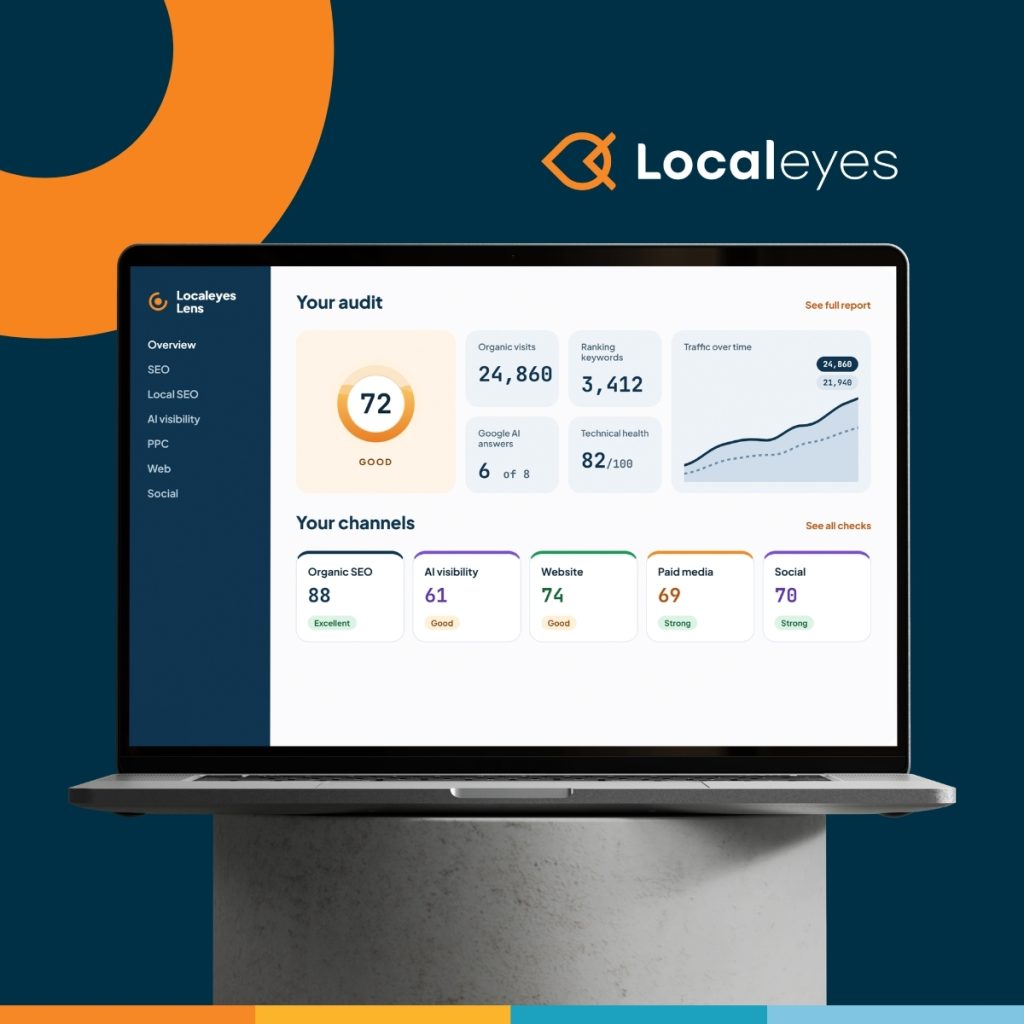
In about a minute, Lens checks how your business shows up across all six places in this guide. Each one gets a score out of 100, with an overall Lens score and a plain-English summary of what to fix first.
“It uses our own scoring and weighting methodology,” Lawrence adds, “developed through years of delivering digital marketing campaigns and seeing what genuinely makes a difference.”
One of our team will then talk you through the results, with no obligation and no hard sell.
Frequently asked questions
How do customers find local businesses now?
Most still start with Google search and Google Maps, but many also check reviews, look at social media and ask AI assistants such as ChatGPT. Most people use several of these before deciding who to contact.
Do most local businesses show up in AI search?
Not yet. Across our first 1,292 Lens audits, AI visibility averaged 45 out of 100, and one in four businesses didn’t appear in any AI answer we checked.
What is a good Lens score?
The higher, the better. A score of 70 or more is strong, but only one in seven businesses we’ve audited reached it. The average was 49.
Is my website the reason I’m not getting found?
Often not. Websites were one of the strongest channels in our audits, averaging 68 out of 100. The bigger gaps were in AI visibility, social media and paid search.
How much does a Lens audit cost?
Nothing. Lens from Localeyes is absolutely free!- takes about a minute and explains what to fix first in plain English.